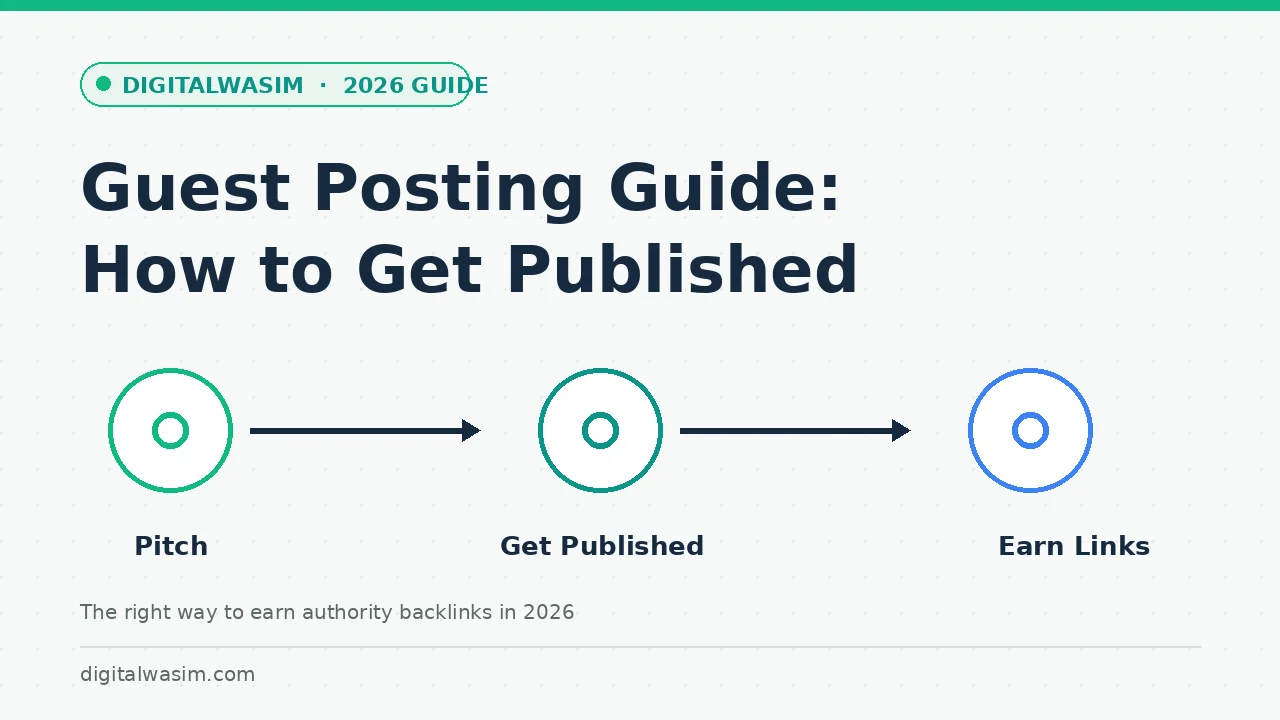
Guest posting has outlived almost every link building trend of the last decade, and the reason is simple: it is the only tactic that rewards you for being genuinely good at your subject. When you write a useful article for another blog in your niche, everyone involved gets something real. The host site gets quality content it did not have to commission, readers get a fresh expert voice, and you get exposure plus a link back to a page you are trying to rank.
The problem is that most guest posting advice on the internet is either outdated or outright dangerous. It tells you to blast hundreds of sites with template emails, stuff every bio with exact-match anchors, and treat any blog that says yes as a win. That approach died years ago, and the sites that still accept it will hurt you more than help you. This guest posting guide covers the modern workflow: choosing targets that actually matter, writing pitches editors reply to, and placing links Google treats as endorsements.
Quick answer:What Guest Posting Is (and What It Is Not)
At its core, guest posting means publishing an article on someone else's website with a short bio and one or two contextual links pointing back to your own pages. Done well, it is a collaboration between two sites that share an audience but not a direct competitor relationship. A blogger who writes about email marketing might guest post on a general small business blog, for example, because both sites serve people building online businesses.
Google's spam policiesThe practical test is embarrassingly simple. Before you pitch any site, ask yourself: would I send this article to my email list even if the link were removed? If the honest answer is no, the placement is a waste of your writing time. If yes, you are guest posting the way editors actually want it done, and the link becomes a side effect of publishing something good.
Does Guest Posting Still Work in 2026?
Every year someone declares guest posting dead, and every year successful bloggers keep doing it. What actually died was the industrial version: spun articles, pay-per-link networks, and guest posts that read like keyword containers. Those schemes got caught by increasingly good spam detection, and the sites that hosted them lost visibility wholesale. The human version, where a real writer contributes a real article to a real publication, never stopped working.
backlink types that consistently matterThe economics also still work in your favor. A single afternoon spent writing one excellent article can produce a link that sends referral traffic for years, especially if the host site ranks well and keeps the post updated. Compare that to buying links monthly with no compounding benefit, and the choice becomes obvious even before you consider the algorithm risk.
How to Find Guest Posting Opportunities That Fit Your Niche
The biggest mistake bloggers make is pitching the first fifty sites that appear in a write for us search. Most of those sites accept anyone, publish anything, and pass none of the signals that make a link valuable. Instead, build a shortlist of twenty targets that meet three criteria: they rank for keywords in your niche, they have published guest authors before, and their content standards are visibly higher than average. Smaller but relevant beats big and generic almost every time.
blogger's free SEO toolkitOne more filter saves more time than any other: read the site's last five guest posts. If they are thin, generic, or stuffed with awkward links, the editor is running a link farm regardless of how professional the site looks. Move on immediately. A rejection from a good site costs you one email; a link from a bad site can cost you a manual action.
The Target-Selection Checklist That Saves Weeks
Once you have a shortlist, score each target against the table below before you spend a single minute writing. The goal is to separate publications that will grow your reputation from content farms that will quietly damage it.
| Signal | Green Flag | Red Flag |
|---|---|---|
| Own rankings | Ranks top 50 for niche keywords | Ranks for nothing except its own brand |
| Guest history | Recent posts by real named authors | Every post is the same anonymous voice |
| Content quality | Specific, experience-based articles | Generic rewrites of search results |
| Outbound links | Varied anchors, relevant citations | Exact-match anchors, casino or pharma links |
| Engagement | Comments, shares, replies from the author | Zero social proof anywhere |
| Editor response | Replies to pitches within a week | No public editor contact at all |
Aim for at least four green flags before pitching. Sites that pass this screen are harder to get into, which is precisely why the link is worth having. The difficulty is the filter that protects your investment.
How to Write Pitches Editors Actually Open
Editors receive dozens of pitches every week, and almost all of them fail the same way: they talk about the sender instead of the publication. A pitch that starts with I am passionate about writing and would love to contribute tells the editor nothing. A pitch that references their recent article and proposes a specific missing topic gets opened.
Use this five-part structure for every pitch. First, a subject line that names the proposed topic, not the word guest post. Second, one sentence proving you actually read the site, citing a specific recent article. Third, the pitch itself: two or three headline-style topic ideas with a promise of what readers will learn. Fourth, one or two links to your best published work, ideally on topics adjacent to theirs. Fifth, a short bio line exactly as it would appear in the post. Keep the whole email under 150 words.
Follow up once after five to seven business days, then stop. Editors are busy, not rude, and a single polite nudge often surfaces your email from the pile. Anything beyond one follow-up damages the relationship you are trying to build. If they pass, thank them and pitch a different angle in a couple of months; plenty of long-term contributor relationships started with a polite no.
Writing the Post: The Quality Bar That Gets You Invited Back
step-by-step blog writing process skyscraper techniqueDeliver on time, in the agreed format, with the images already sized. Then accept edits gracefully. An editor who reshapes your draft is not insulting you; they are fitting it to an audience you do not know yet. Contributors who argue over every comma rarely get invited back, and repeat invitations are where the real value of guest posting lives.
Anchor Text and Links: The Safe Way in 2026
Links are where guest posting gets dangerous for careless people. The safe rule is one or two contextual links maximum per post, placed where they genuinely help the reader, with anchor text that describes the destination honestly. A link that says how I doubled my email open rates pointing to your email marketing guide is natural. A link that says best email marketing software pointing to your homepage is a pattern Google's systems are trained to find.
Google's crawlable links guideBio links deserve their own discipline. Write a bio that states what you do and offers a reason to click, then point it at a page built to convert that visitor, such as a specific guide rather than your homepage. You did the hard work of earning the reader; send them somewhere that continues the journey.
A Repeatable Guest Posting Workflow
A repeatable workflow turns guest posting from a scramble into a system. Run this loop monthly and your link profile will grow steadily without ever tripping spam filters:
- Pick one target from your scored shortlist and read their last three guest posts.
- Send a specific, personalized pitch with two or three topic ideas.
- Write the article to their standards, adding original data or frameworks.
- Deliver on time, respond to edits quickly, and thank the editor after publication.
- Promote the post to your audience and reply to comments for the first week.
- Record the placement, the link, and the referral traffic in a simple tracker.
- Propose a follow-up topic six to eight weeks later to deepen the relationship.
Notice that only one step involves writing. The rest is research, relationship, and follow-through, which is exactly where most bloggers cut corners and most successful guest authors invest.
Mistakes That Get Guest Posts Rejected
Before we close, a quick blacklist of the behaviors that get submissions rejected or pages penalized. Avoid these and you will outperform most contributors you are competing against:
- Pasting a generic pitch with the site name swapped in, or worse, a competitor's name left in by mistake.
- Proposing topics their site has already covered multiple times because you never read the archive.
- Sending a first draft full of self-promotional links when the guidelines clearly allow one.
- Choosing host sites with no topical overlap just because their write for us page loads fast.
- Disappearing after publication instead of promoting the post and answering comments.
- Asking for dofollow links, payment terms, or anchor text changes in the very first email.
Every one of these mistakes is avoidable with ten minutes of reading and a little patience. That is the real secret of guest posting in 2026: the bar is low for people who care, and impossibly high for people who spray and pray.
Guest posting rewards the same qualities that make blogs successful in general: genuine expertise, generosity, and consistency. Start with five carefully chosen targets this month, pitch two, publish one, and track what happens. Then repeat. Twelve excellent placements over a year will do more for your rankings and your reputation than a thousand forgettable links ever could, and every one of them will be something you are proud to put your name on.